Hoijeon Moosool Hapkido
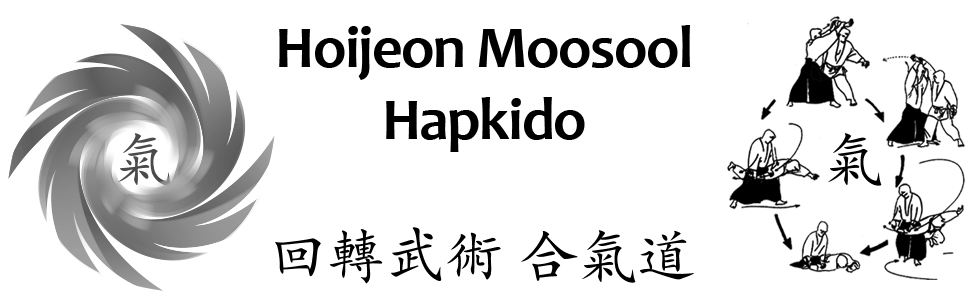
바다의 소용돌이는 큰 배도 침몰시키고 - A whirlpool in the sea can sink even a great ship
What is Hoijeon Moosool?
Hoijeon Moosool (회전무술 / 回轉武術) is a Korean martial art.
Created by Grandmaster Myung, Jae Ok and rooted in Korean Hapkido (합기도 / 合氣道), Hoijeon Moosool literally translates to “rotational martial art”.
The core idea is simple: rather than meet force straight-on, turn. More poetically, GM Myung instructs us to harness the power of a whirlpool to merge, neutralize, and overcome adversity.
Hoijeon Moosol is for adults and teens interested in self-defense based on mechanical advantage rather than fighting with power or big muscle. We train structure over strength, and timing over tension, utilizing circles, arcs, and spirals to assimilate and disperse incoming power, break posture, and take control.
Principles of Hoijeon Moosool
- 분심 (bun-sim): disrupt the opponent’s intent.
- 분력 (bun-ryeok): disperse the opponent’s power/energy (usually through rotation).
- 동화 (dong-hwa): assimilate and reroute the opponent into your motion.
These aren’t slogans; they’re the filter for every interception, entry, off-balance, lock, or takedown we teach. If you’re missing any of the above, it’s not Hoijeon Moosool.
Tu Ki (투기) - Self-Protection
In Hoijeon Moosool, effective self defense is the priority. As such, this section forms the majority of our practice and curriculum. Core mechanics include
- Structure & posture: move from the Danjeon (lower center); align head–heart–hips; stay relaxed but rooted.
- Entries & off-balancing: take angles; use strikes and joint controls to create space; steal posture before you control.
- Joint safety & control: apply locks with partner care; partner care is non-negotiable.
From here we use rotation and leverage, using the opponent’s anatomy against them. Progressions move from compliant reps to timed reactions.
Integrated striking
One of the biggest differences between Hapkido (Hoijeon Moosool is a version of Hapkido) and Aikido is that we are not pacifists. Rather we have no qualms “passing-a-fist” to defend ourselves. As such, purposeful striking to vital and vulnerable points is an important to set up for our techniques. Hand, foot, knee and elbow work blends directly with entries setting up rotation, control, and ending the encounter.
Kyeok Ki (격기) - Basic Striking
Striking & defensive technique. In the “kickboxing” portion of HJMS, we cover modern and practical techniques including:
- Punches: jab, cross, hook, uppercut
- Elbows: forward and backward
- Hands/palms: knife-hand, palm-heel, hammer-fist
- Defensive hands: parries, “sticky hands,” covers
- Head movement: slip, bob, weave
- Shields: elbow shields vs. kicks (advanced)
- Kicks: front, round, side, back, hook, low, sweeps, etc.
Mu Ki (무기) - Weapons
With this, we figure less is more: Jung Kum (medium sword), Jang Bong (long staff), Jung Bong (medium staff). Fewer tools, deeper skill.
- A few solo and partner forms for sword and staff
- Basic cuts/strikes with hoi-jeon (rotational) lines built in
- Simple application chains that mirror empty-hand mechanics
Hwal Ki (활기) - Health/Anatomy
Understand the body so control needs less force.
- Where to place hands/forearms; align bones over joints
- Use point sensitivity to disrupt posture without muscling
- Train posture and breath to reduce tension and prevent self-injury
Nae Ki (내기) - Internal Work
Work the “inside”: breathing, relaxation, intention, attention, and set movement patterns.
- Danjeon breathing: move and breathe from the root
- Coordinate circular motion with breath
- Usually practiced at the start of class to set the tone
Nak-beop (낙법) - Proper Falling
Learn how to absorb, redirect, and survive impact so you can keep fighting or get up safely. Truthfully this is likely one of the most applicable skills you may learn in training with us. Not many people get into fist fights these days, but Michigan winters are quite slippery every year!
Basic considerations for safe and proper falling in HJMS include:
- Protect first: chin tucked, elbows in; protect head/neck/spine.
- Disperse impact: widen contact; forearm/hand slap; exhale on contact.
- Rotate if possible: side/back/forward rolls beat straight drops.
- Guard the center: land on the flanks; don’t gift your arms or midline.
- Recover with intent: technical stand-up or knee-base rise; angle out.
Overall, the goal of our Hoijeon Moosool program is to provide a place for students to develop a rounded skillset for self-defense, a grounded sense of self-confidence, a strong and flexible body and an agile and sharp mind.
Our academy is the only school in Michigan with certified World Hoijeon Moosool Federation (WHJMS) instructors officially sanctioned to teach Hoijeon Moosool.
Interested? Contact us to begin with our 9-week trial for $99.